
What does it take to build trust, lead effectively and grow a business in Japan? In this episode, we explore the holistic nature of Japanese leadership, why trust is the currency of business and how Japan’s post-bubble years may have given rise to the risk-averse manager.
We also examine how introversion can become a leadership strength and consider the relationship between ikigai, kokorozashi and the North Star that gives our lives and work direction.
Timothy Connor

Timothy Connor is a bilingual and bicultural entrepreneur who has called Tokyo home for more than 30 years.
During that time, he has developed an extraordinary depth of expertise in the Japanese consumer market, with a particular focus on customer experience, marketing strategy, e-commerce, and luxury and consumer goods.
As CEO of Synnovate, Timothy helps foreign brands successfully enter and grow in the Japanese market.
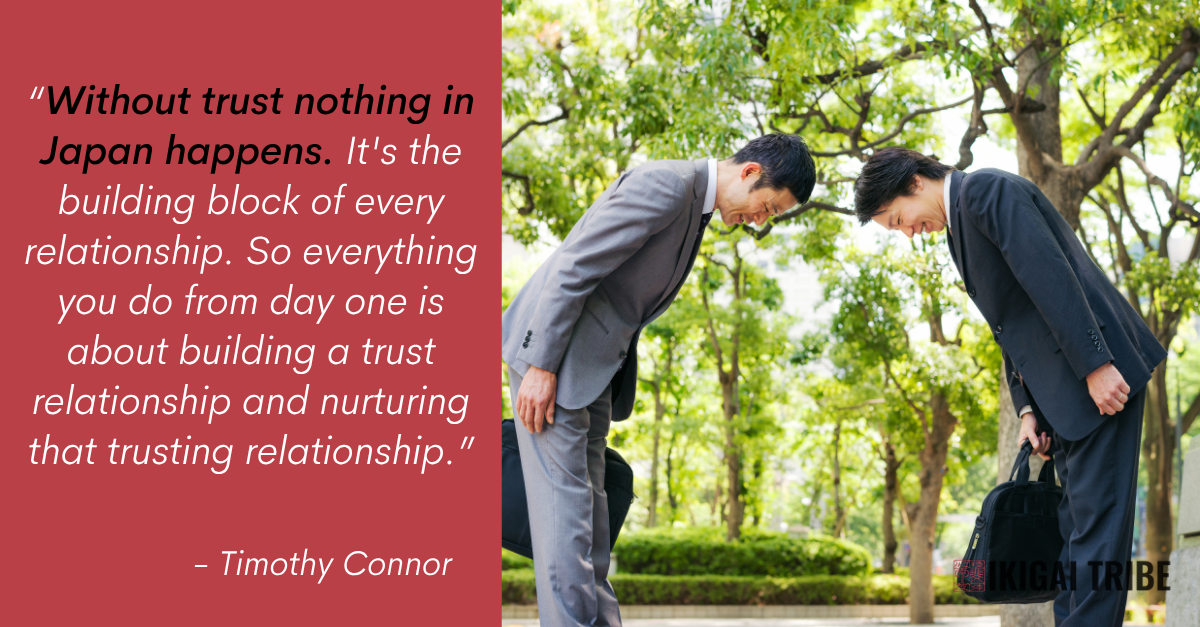
“Without trust nothing in Japan happens. It's the building block of every relationship. So everything you do from day one is about building a trust relationship and nurturing that trusting relationship.” - Timothy Connor
JET
Timothy Connor first came to Japan through the JET Programme, although Japan had not originally been part of his plan. Having previously studied in Paris, he assumed he would return to Europe after graduating. However, after taking Japanese at college almost on a whim, he was encouraged by his teacher to apply for JET.
During his interview, Timothy was asked what he thought would be the most challenging possible placement. He replied that it would be living somewhere with no other English speakers—and that was precisely the experience he was given. He spent two years in Morioka, Iwate Prefecture, beginning what would become a life and career in Japan spanning more than three decades.
After moving to Tokyo, Timothy found work at a school and quickly became a manager responsible for 70 teachers. At the same time, he discovered that a Parisian fashion design school had opened a campus in Japan. Having always loved fashion, he applied and was accepted.
Timothy describes this period as the first phase of his career. He found himself working at the intersection of creative, right-brain activity and analytical, left-brain responsibility. While studying fashion design, he was also managing schedules, counting working hours, teaching and learning elements of pre-sales. This combination of creativity and commercial thinking would remain a defining feature of his career.
After several years, Timothy launched his first company, initially as a fashion design business. It later evolved into interior design and the importation of designer products. He eventually decided that he needed experience within a larger corporate environment and joined a major Japanese conglomerate.
Timothy was asked to run one of the conglomerate’s subsidiaries. After the subsidiary closed, he spent three years working directly under the company’s founder and chairman—a larger-than-life, Showa-era industrialist with connections at the highest levels of Japanese society.
The chairman took a liking to Timothy and allowed him to remain employed while travelling back and forth to Duke University to complete his MBA. Once Timothy graduated, the chairman gave him some direct career advice: it was time for him to work for an American company.
Timothy initially started his second business, a consulting company. One of his clients, an American CEO, hired him for a project but, rather than simply paying him for the work, invited him to join the company.
This began the third major phase of Timothy’s career. He spent 12 years at Newport, serving as the second-in-command to the CEO. As it was a small to medium-sized enterprise, Timothy became involved in almost every aspect of the business. The company focused on introducing new products and services into Japan, giving him extensive experience in retail, wholesale, direct sales and distribution. He describes this as the period in which he learned the most about bringing products into the Japanese market.
Timothy was later recruited by investors in Texas to establish a retail electricity company in Japan. When that venture ran out of capital, he moved to another American-owned electricity start-up, which he helped turn around before assisting its owner with its sale at the end of 2019.
Synnovate
In January 2020, Timothy founded Synnovate—just weeks before the world was transformed by the COVID-19 pandemic.
As CEO, he now helps foreign businesses enter and grow in the Japanese market. His work involves developing strategic road maps, leading their implementation and collaborating closely with local master distributors and franchise partners.
Trust is the currency of business in Japan
Central to Timothy’s approach is his bilingual and bicultural ability to build relationships between overseas brands and their Japanese partners. He works to establish the trust required to innovate across products, sales and marketing channels, and promotional activities.
For Timothy, trust is the currency of business in Japan. It is difficult and time-consuming to earn, but very little can be accomplished without it. His success has come not merely from understanding how the Japanese market operates, but from developing the cultural awareness, patience and credibility required to form lasting business relationships.
The holistic appraoch
Although Timothy comes from the United States, which he characterises as a more specific-thinking culture, his years in Japan have led him to embrace a more holistic approach to leadership, management and consumer behaviour.
His longstanding interest in the intersection between creative and analytical thinking eventually led him to behavioural psychology. Learning about consumer behaviour and cognitive biases gave him a more multifaceted understanding of how people make decisions.
This now shapes his approach to market entry and growth in Japan. Rather than relying on isolated initiatives, he advocates for an integrated omnichannel ecosystem that maximises a brand’s visibility and takes advantage of the mere-exposure effect—particularly important when building familiarity with Japanese consumers.
A model of strategic leadership
Timothy has also developed his own model of strategic leadership, which identifies the leadership capabilities a business requires at different stages of its development:
- Launch leadership – establishing a new venture and bringing an idea to market
- Growth leadership – guiding a business through expansion
- Transformational leadership – leading significant organisational change
- Resilient leadership – helping a business respond and adapt to adversity
- Advocate or evangelist leadership – championing the business and inspiring others to believe in its vision
This skills-based approach reflects Timothy’s belief in a growth mindset and his recognition that the leadership a business needs will change as the organisation evolves.
Having worked in Japan during the growth and collapse of the economic bubble, Timothy also offers a distinctive perspective on the risk aversion often associated with Japanese management.
His theory is that the modern risk-averse Japanese manager is largely a business and social construct that emerged after the bubble burst. During the long period of economic stagnation that followed, survival became the primary objective for many organisations. Over time, caution and complacency became embedded in corporate culture.
In Timothy’s view, it would be inaccurate to describe the managers of Japan’s high-growth and bubble eras as inherently risk-averse.
Timothy also reflects on how being a true introvert has become a professional advantage in Japan. The quieter nature of Japanese society gave him the space to discover and develop his public voice without being drowned out.
This contrasted sharply with his experience working in louder American business environments, where the loudest voice in the room often seemed to prevail.
Beyond business, Timothy is drawn to Japan’s spiritual relationship with the everyday. Inspired by Hiroko Yoda’s book Eight Million Ways to Happiness, he appreciates the Shinto understanding that spirituality is not confined to a distant divine being or even to the shrine itself.
Instead, spirituality, richness and the possibility of happiness can be found all around us if we learn to perceive the world in that way.
Ikigai
This holistic outlook also informs Timothy’s understanding of ikigai. He sees ikigai as a result or discovery rather than a framework—an understanding closely aligned with the work of pioneering ikigai researcher Mieko Kamiya.
From a Japanese perspective, ikigai does not necessarily include what someone can be paid for. People may have a sense of their ikigai without needing to define it precisely or reduce it to a single statement.
Timothy connects this ambiguity with the holistic and indirect nature of Japanese communication. A shared cultural background often allows meaning to remain implicit rather than being explicitly articulated.
Having lived in Japan for so long, Timothy feels that he has acquired much of this shared cultural understanding himself. Embracing holistic thinking has, he believes, made him a better leader, manager and colleague.
When speaking with GLOBIS MBA students and start-up founders, Timothy offers a memorable way of distinguishing between three ideas:
- Ikigai is what gets you up in the morning.
- Kokorozashi is what keeps you going.
- Your North Star is where you are going.
Your North Star may change position, but it continues to shine brightly and provide direction.
After more than 30 years in Japan, Timothy now wonders whether sharing what the country has taught him—through his unlikely journey as an entrepreneur, leader and bridge between cultures—may itself be his ikigai.