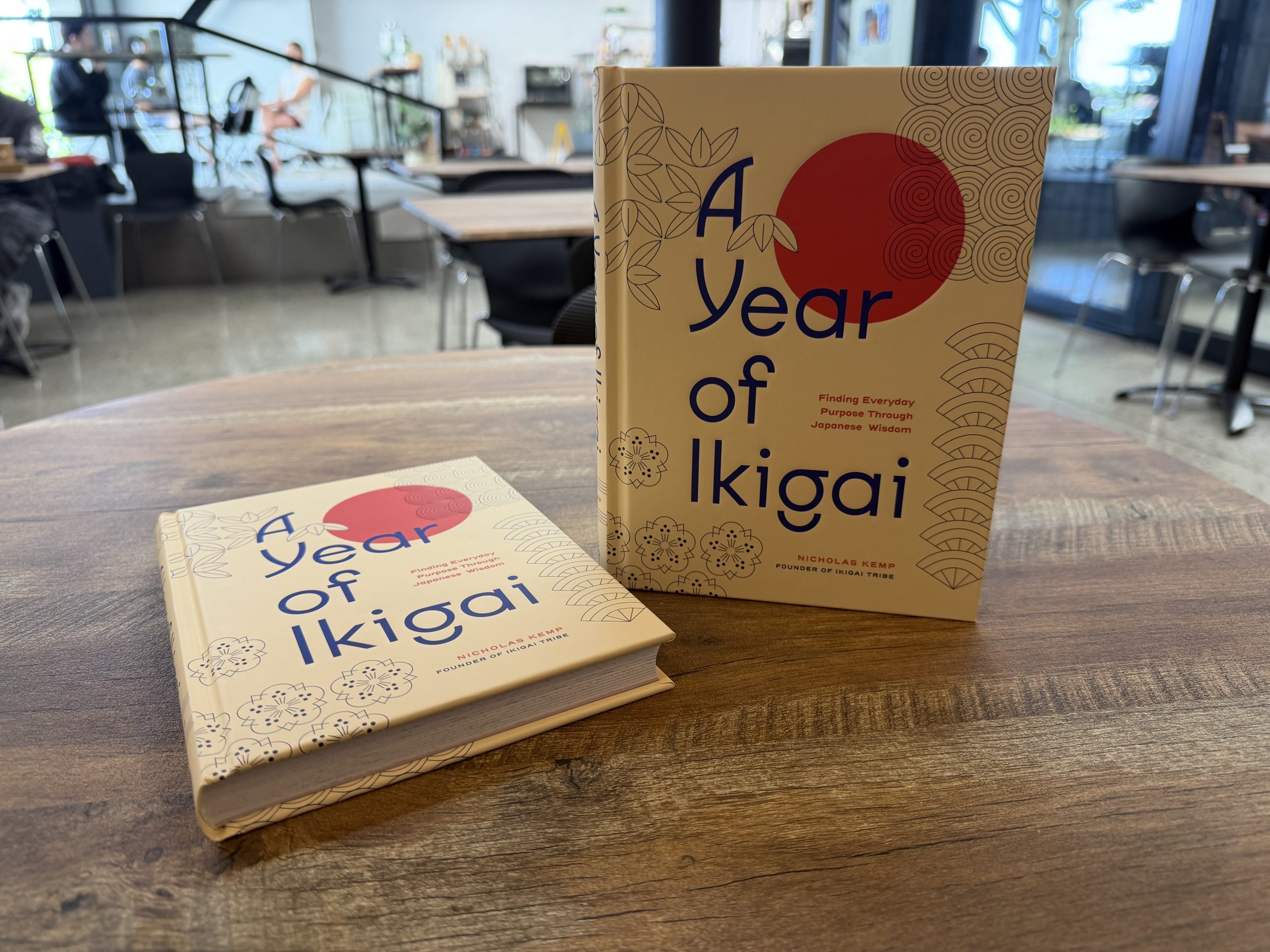
Are you ready to take a year-long journey of ikigai?
In this episode of The Ikigai Podcast, Nick reads the introduction to his new book, A Year of Ikigai: Find Everyday Purpose Through Japanese Wisdom.
Nicholas Kemp

Nicholas Kemp is an international keynote speaker and corporate facilitator. He holds a Diploma of Positive Psychology and brings long-standing experience working with Japanese psychological concepts into leadership, organisational, and cultural contexts.
As an author, Nicholas has written A Year of Ikigai, Ikigai-Kan: Feel a Life Worth Living, and Rolefulness. His writing explores meaning as it is lived and experienced in everyday life, with a particular focus on roles, relationships, contribution, and belonging.
A YEAR OF IKIGAI
Find Everyday Purpose Through Japanese Wisdom
Introduction
The fact that you’re alive to read these words is nothing short of a miracle. Thousands upon thousands of generations in your ancestral chain all lived long enough, met, and procreated at the exact right time to eventually produce you. In short, you and I won the jackpot in the evolutionary lottery. Yet, we don’t treat life as a miracle. Most of the time, we struggle to get through each day. The Japanese concept of ikigai reminds us that life is a miracle—a patchwork of small wonders and special moments, once-in-a-lifetime experiences and life-changing opportunities we can embrace, nurture, and appreciate if we choose to do so. In short, having ikigai makes life feel worth living.
For close to a decade, the West has had a fascination with ikigai, believing that it is a concept from Okinawa, the secret to living a long and happy life, and a sweet spot where you find your dream job or bliss in life. Best-selling books, numerous TED Talks, thousands of blog articles, and endless social media posts perpetuate and continue to promote false notions of what ikigai is and what motivates Japanese people to get out of bed in the morning.
Unfortunately, many common Western thoughts are nothing more than romanticized interpretations that have misled millions of people into believing that ikigai originates from a “blue zone,” a part of the world that has a high concentration of centenarians. Another false interpretation is that ikigai must be something you love, are good at, that serves the world, and can be paid for in order for you to experience it.
The truth is, ikigai encompasses all aspects of one’s life with an emphasis on the intrinsic elements that provide a sense of meaning and fulfilment. Ikigai includes life-affirming facets we might relate to positive psychology such as life satisfaction, growth, hope, social affiliation, freedom, self-actualization, meaning, and purpose.
A closer look at the word ikigai
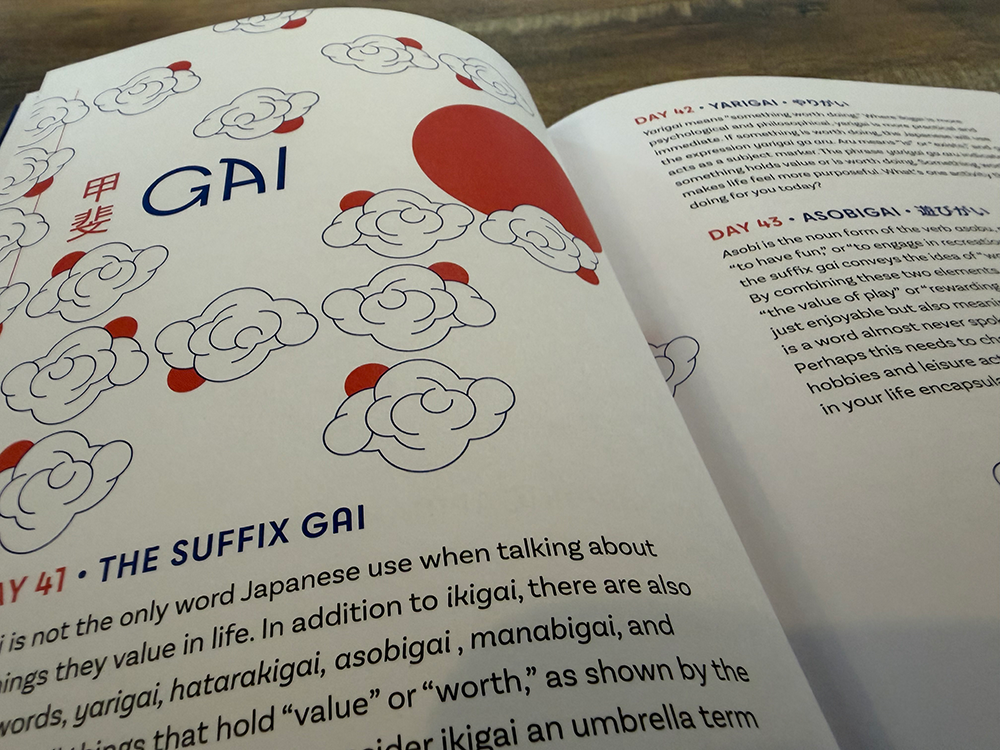
A closer look at the word—and its kanji, 生き甲斐—helps us understand ikigai’s meaning and application. Ikigai is a compound of two terms: iki(from the verb <I>ikiru<$> 生きる), meaning “to live,” and gai,(甲斐), meaning “value” or “worth.” In a nutshell, ikigai is what you live for—what makes your existence meaningful.
If we take a closer look at the kanji of the suffix kai, (甲斐), it leads us to a deeper level of understanding. The first character, 甲, means “armor” or “shell,” suggesting that ikigai includes the things that protect you or help you cope with life. The second character, 斐, indicates something “beautiful” and “patterned,” much like how life is a tapestry. Together, these two kanji suggest that ikigai encompasses both the things that help you endure life’s challenges and enjoy the beautiful moments, and experiences that make life feel worth living.
Here, it is crucial to understand what we mean by “life.” We are not referring to your life in the broad, existential sense—ikigai is rooted in daily existence, in the small, meaningful moments that shape everyday life. Ikigai is not made of grand plans or embracing an all-or-nothing attitude. Ikigai is what you make of everyday life.
Despite the growing popularity of ikigai in the West, the irony is that most Japanese rarely use the word or consciously think about the concept in daily life. For Japanese people, ikigai is something they feel rather than talk about. If they do discuss it, it’s often in a casual way, much like they would speak about their hobbies. Ikigai isn’t a grand life philosophy or a structured framework—it’s simply something that brings joy and a small lift to life. Ultimately, ikigai is personal and unique to each individual. For a new parent, it may be their child. For an entrepreneur, it may be their work. And for an alcoholic, it may be booze. There’s no universal “right” or “wrong” ikigai, but it can be deeply life-affirming.
When Ikigai Found Me
Ikigai entered my life more than twenty-five years ago, in 1998, through a casual conversation I had with a Japanese coworker on the first day of a job in Tokyo. My coworker’s explanation of ikigai filled me with excitement and left me intrigued. I couldn’t believe the Japanese language had a single word that encapsulated what makes our life worth living; the reasons we battle on through life.
The following day, keen to learn more about ikigai from my Japanese coworker, I was disappointed to learn that she had been transferred to another office. More immediate matters got in the way that day, the word ikigai quickly went into hibernation somewhere in the recesses of my brain, and my life moved on.
Twenty years later, I encountered the word again in the center of a four-circle Venn diagram with the following questions: Are you doing something that you love? Are you doing something that you're good at? Are you doing something that the world needs? Are you doing something that you can be paid for? In the center, where all four circles overlap, was the word <I>ikigai.<$>
It is believed and perpetuated by many Westerners/non-Japanese that as ikigai lies at the center of these interconnecting circles, if you are lacking in one or more of these areas (e.g., you are doing something that you love and are good at, but are not serving the world or making money from it), then you can’t experience ikigai and are therefore missing out on living a meaningful and fulfilling life. This is obviously not the case.
Seeing ikigai defined with a Venn diagram was very . . . unJapanese. I passed it off as a Western interpretation and chose to ignore it. But weeks later, I started seeing the word ikigai and this Venn diagram more and more on the web. It was everywhere: on LinkedIn, Facebook, Twitter (now X), and Instagram. I found the word as the subject of blog posts and TED Talks, all sharing this Venn diagram interpretation of ikigai.
The Ikigai Journey Begins
Then one day, I was shocked to discover the Venn diagram as the ikigai concept on the World Economic Forum website. Horrified by this cultural appropriation being branded on such a trusted and credible website, I felt something had to be done about it. That was the spark that started my journey, and a podcast, to uncover the mystery behind the Venn diagram and the truth about ikigai.
Six years on, and the journey to understanding ikigai has dramatically changed my life. For one, I'm writing this book. Through my podcast, The Ikigai Podcast, which explores ikigai from the perspective of the Japanese, I have connected with many inspiring Japanese academics, researchers, artists, tea masters, Shinto priests, Zen monks, as well as everyday people who were willing to share their ikigai. The podcast led to me establishing a coach training business and building a community of inspiring coaches and educators I call the Ikigai Tribe. And more recently, ikigai has brought me back to Japan, and I now take business leaders, coaches, and entrepreneurs on ikigai retreats—Japanese cultural study trips where guests can experience ikigai in Japan with locals through cultural practices and traditional craft.
The Mother of Ikigai
According to Japan’s research pioneer, Mieko Kamiya, whom I like to call the Mother of Ikigai, the word ikigai refers to the sources of value in one’s life—the things that make one’s life worthwhile. These sources could include people, roles, relationships, work, hobbies, goals, dreams, and even memories. The life-affirming feelings that arise from these sources—the deep awareness that life is worth living—are called ikigai-kan, with kan meaning “sense, perception, awareness of feeling.”
In short, ikigai is what makes life feel worth living.